
Local AI · Offline · Browser game
Build Super Mario Web Edition for $0
An informal test ride of local-model prowess: one prompt, Wi-Fi off, and a playable web platformer four hours later.
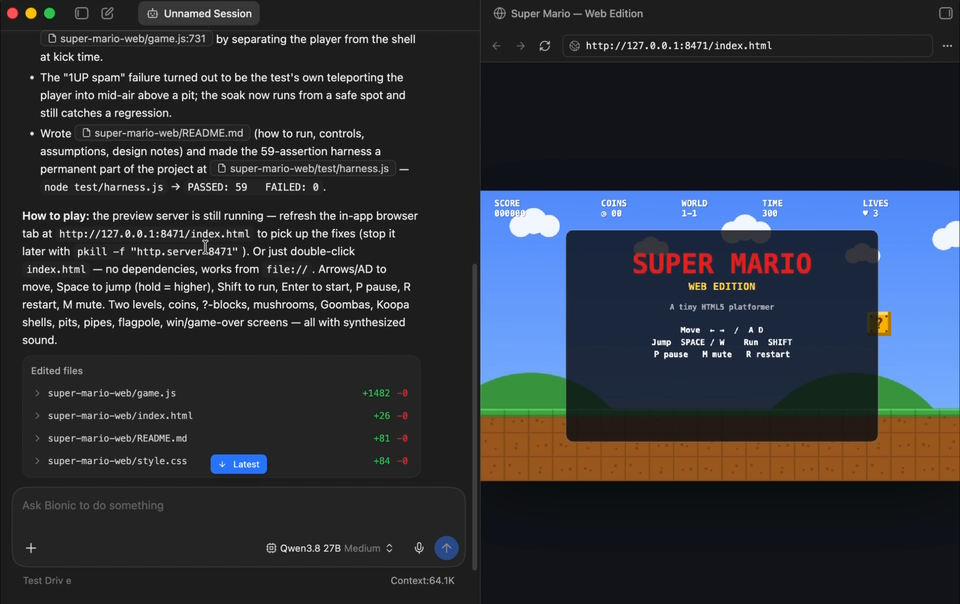
I asked a local Qwen3.8 27B model in LM Studio to make suitable assumptions and build a Super Mario-style game for a web browser. After the model was already on the laptop, the run used no cloud inference, no API credits, and no follow-up prompts.
Create Super Mario game which can be played in a web-browser. Make suitable assumptions.
This is a practical, single-run experiment. It is not a benchmark or a broad claim about model quality. The result is still notable: a self-contained game with no dependencies, external assets, or network requests.
Watch the local run
The capture shows the prompt in LM Studio and the resulting game being played in a local browser session.
Play the artifact
The generated game is published as-is. Use arrow keys or A /
D to move, Space to jump, Shift to
run, P to pause, and R to restart.
Verified artifact
- 1,592 lines across HTML, CSS, and vanilla JavaScript
- Canvas visuals and synthesized WebAudio; no downloaded art or libraries
- Two levels, power-ups, enemies, shells, pipes, timer, pause, and restart
- 59 passing headless tests covering gameplay and render states
- Runs directly from
file://without an internet connection
Download the source
The generated HTML, CSS, JavaScript, README, and test harness are available as a zip of the original evaluation folder.
Download super-mario-web-source.zip
Tools used
- LM Studio for local, offline inference
- Qwen3.8-27B open-weights model
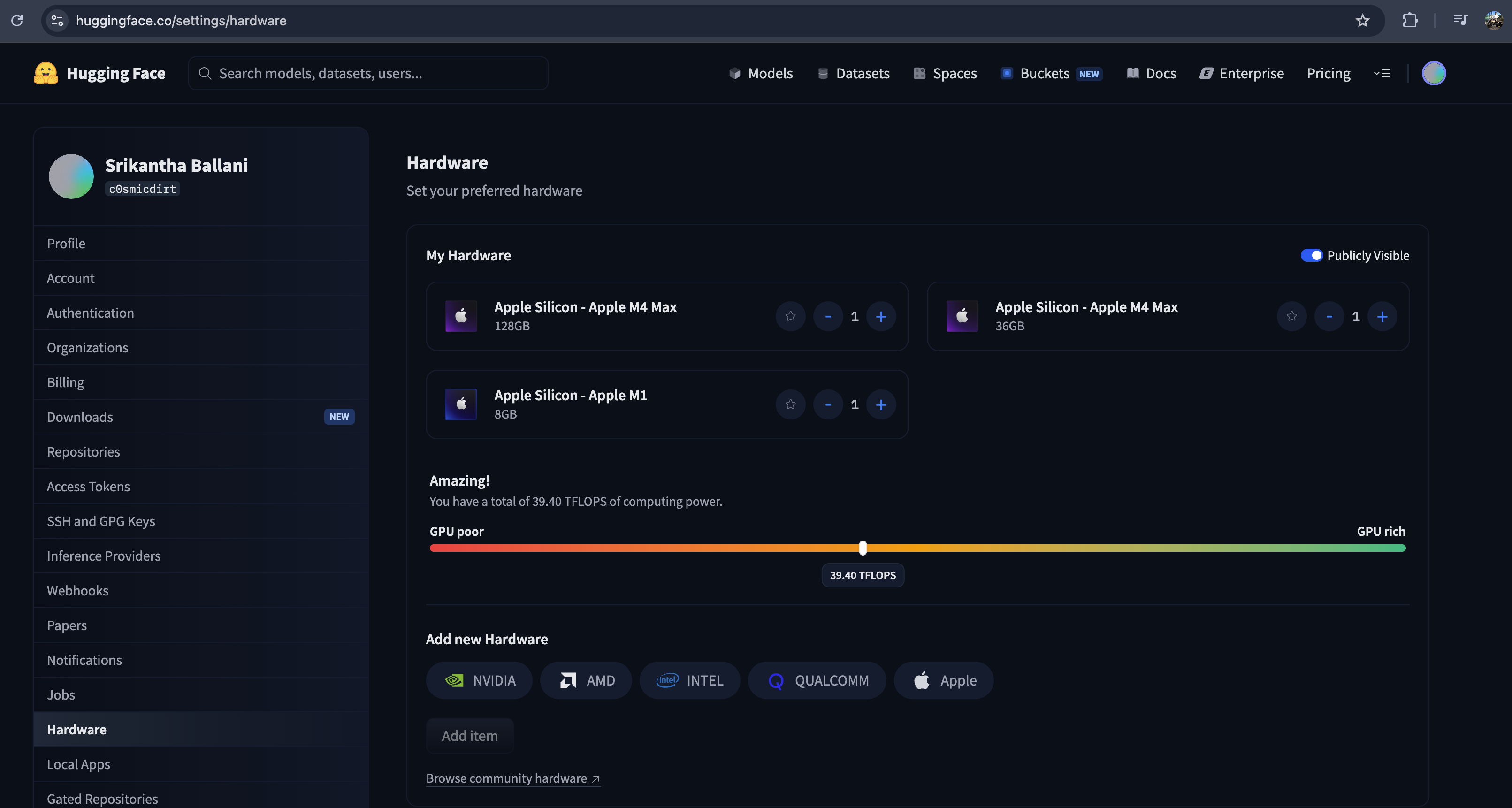
GPU poor, still useful
Hugging Face's GPU Poor framing fits this run: personal compute is enough to ship a complete prototype when the model is small enough to run locally.
Why it matters
Local and edge models can make experimentation cheaper, more private, and more resilient when a task fits personal hardware. This small test does not replace disciplined engineering, but it shows how a useful prototype can be created where the marginal cost is closer to electricity than metered cloud inference.